
The most beautiful villages in Catalonia
People often come to Catalonia for Barcelona. They come back for its villages. An hour or two from the city, they tell the story of another Catalonia, one of stone, forests, Romanesque bell towers and squares where people take their time. Here are ten villages that are worth the trip on their own.
In the Empordà, golden stone
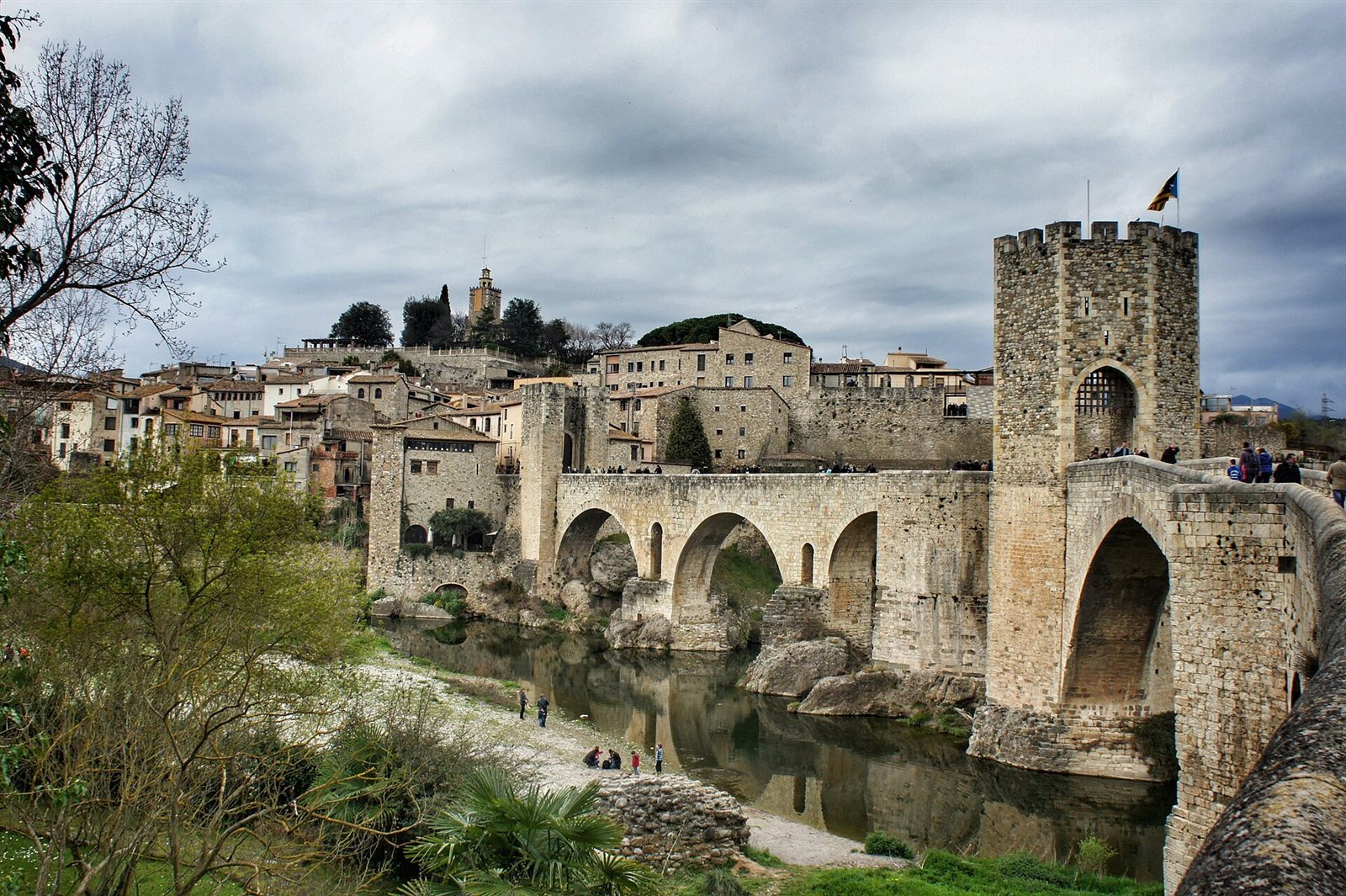
Besalú. You enter over a long, fortified medieval bridge with a bend in it, spanning the River Fluvià. Behind it lie cobbled lanes, a Romanesque church and the memory of a large Jewish community: its miqvé, a 12th-century ritual bath, is one of the few still preserved in Europe.
Peratallada. Its name means “carved stone”, and everything here is stone: the houses, the walls, the castle, even the moats cut into the rock. In the evening, when the stone turns golden, it’s one of the loveliest places in Catalonia.
Pals. A medieval village on a hilltop, with towers and beautifully restored lanes. Below stretch the rice fields of Pals, and in the distance, the sea.
Cadaqués. At the very tip of Cap de Creus, white houses tumble down to a bay of clear water. Cut off for centuries, this fishing village drew Picasso, Duchamp and above all Salvador Dalí, whose house at Portlligat, just next door, is open to visitors.
In the mountains and volcanoes
Rupit. In the heart of the Collsacabra, a village of stone houses with wooden balconies, reached by a suspension footbridge over the stream. In winter, when the mist comes down, it feels like a fairy tale.
Tavertet. Perched on the very edge of a dizzying cliff above the Sau reservoir. The view from the edge of the plateau is one of the most spectacular in the country.
Santa Pau. Among the volcanoes of the Garrotxa, a perfectly preserved arcaded square, the Firal dels Bous, and a speciality: Santa Pau beans, fesols, grown in the volcanic soil.
Heading south, between vineyards and river
Montblanc. Its medieval walls are almost intact, and the town lays claim to a famous legend: this is where Sant Jordi (Saint George) is said to have slain the dragon to save the princess. Every April, Medieval Week brings it back to life.
Siurana. A tiny village sitting on top of a cliff in the Priorat. It was the last Muslim stronghold in Catalonia, falling in 1153. Today it’s a climbers’ paradise and the gateway to the Priorat vineyards.
Miravet. On the banks of the Ebre, a white, terraced village crowned by a Knights Templar castle. To reach it from the other bank, you can still take the pas de barca, a traditional ferry that crosses the river carried by the current, with no engine.
How to visit
Most of these villages are small and live at a gentle pace. A few tips to enjoy them at their best:
- come on a weekday or out of season: in August, Pals and Peratallada get very busy at weekends;
- park at the edge of the village: medieval lanes weren’t built for cars;
- stay for lunch: every village has its speciality, and the Empordà is one of Europe’s great food regions;
- say hello in Catalan: a bon dia as you walk into a shop always goes down well.
Village words
- el poble: the village
- la plaça: the square
- el carrer: the street
- el campanar: the bell tower
- les muralles: the town walls
- Quin poble més bonic!: what a pretty village!
You’ll probably get to say it more than once.
Photo: Besalú and its medieval bridge, by Los Paseos from Earth (CC BY-SA 2.0, Wikimedia Commons).